
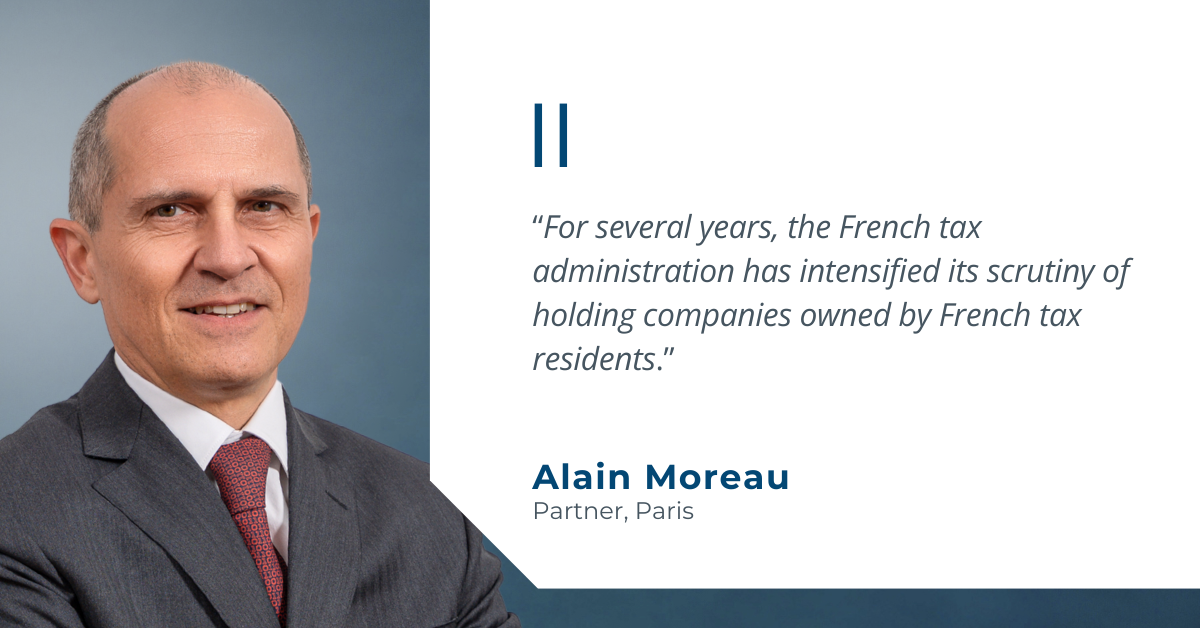
For several years, the French tax administration has intensified its scrutiny of holding companies owned by French tax residents. These companies are accused of having their place of effective management in France due to an alleged lack of sufficient substance abroad. This position is increasingly supported by case law, as illustrated by a recent decision rendered by the Versailles Administrative Court of Appeal on 8 January 2026.
In this case, a Luxembourg holding company created by a French family to hold shares in subsidiaries and patents, was at the heart of the controversy. The holding company, receiving passive income in the form of dividends, interest, and royalties, was accused by the tax administration of being, in reality, a French tax resident.
The company’s defense relied on several points: holding its board meetings in Luxembourg, the absence of premises in France, and the fact that its activities did not require significant human or material resources. However, the Court held that these arguments were insufficient to contest the tax reassessment.
The Court’s decision was based on several findings: firstly, although domiciled in Luxembourg, the company had no resources of its own there, as all its services were provided by external service providers. Secondly, one of the shareholders, a French resident and director, played a central role in steering and validating decisions, indicating a degree of dependence on France. Thirdly, the Luxembourg service providers lacked decision-making autonomy and acted on the instructions of a French accounting firm.
Another controversial aspect of the case lies in the application of the 80% penalty for undisclosed activity, notwithstanding the fact that tax returns had been duly filed in Luxembourg. This decision raises concerns regarding freedom of establishment within the European Union, particularly concerning passive holding companies.
The Court sided with the tax administration, emphasizing a strict material interpretation of the substance required for a company to be considered as tax resident abroad, while disregarding its immaterial substance. It thus seems to demand more material substance from foreign holding companies (notably offices and employees) than it does from passive French holding companies. It is, however, unrealistic to consider that a holding company limited to receiving passive income (notably dividends or royalties) requires dedicated logistics, which are often entirely unnecessary given its actual activities as a purely passive holding company.
Legal, banking and accounting professionals must therefore be particularly vigilant in light of the tightening approach observed in France. The Conseil d’Etat, France’s supreme administrative court, is expected to rule on this issue soon, and it is hoped that it will set clear guidelines capable of securing cross-border structuring schemes.
Alain Moreau
Partner, Paris