In recent years, cases involving Swiss companies abroad – particularly proceedings initiated by foreign authorities in connection with the cross-border activities of certain Swiss financial intermediaries – have helped to bring to light a criminal law provision that had previously been overlooked. Adopted in 1935, Article 271 of the Swiss Criminal Code (SCC) aims to protect Switzerland’s sovereignty by stipulating that only Swiss public authorities may carry out official acts on Swiss territory.
Thus, under Article 271(1)(1) of the Swiss Criminal Code, anyone who, without authorisation, carries out acts on Swiss territory on behalf o f a foreign state that fall within the remit of public authorities is liable to criminal penalties, including imprisonment. Although the original intention of the legislature was to crack down on military intelligence activities by “foreign states” on Swiss soil, the criminal provision now also applies to anyone who collects evidence within a company in connection with administrative, criminal or even civil proceedings initiated abroad without complying with certain rules of caution.
A thorough analysis of the situation is required before collecting internal data or contacting employees.
As genuine “repositories” of information, companies based in Switzerland are frequently targeted by requests from foreign authorities seeking access to client data, employee information, or trade secrets.
In practice, evidence gathering has become commonplace, given how often such companies are called upon—voluntarily or otherwise—to cooperate by providing information or designating employees to testify in civil, criminal, or regulatory proceedings conducted abroad.
While such actions may appear innocuous and are sometimes justified by the protection of the legitimate interests of the entities concerned, the fact that they are undertaken at the request of a “foreign state” and carried out on Swiss territory renders the individual concerned potentially liable under Article 271 SCC. A detailed legal analysis is therefore required before collecting internal data or contacting employees.
Acts that “fall within the scope of public authority” within the meaning of the criminal provision—and a fortiori those covered by international mutual assistance—include not only the service of judicial or extrajudicial documents, but also, more broadly, the taking of evidence, such as the examination of witnesses, the hearing of parties, the production of documents, or requests for expert opinions.
As a result, Article 271 SCC is frequently described as a blocking statute, in that it may, in certain circumstances, prevent the cooperation of a natural or legal person located in Switzerland in the context of proceedings pending abroad. In this setting, the collection of evidence intended for such proceedings must be organized with the utmost care in order to avoid criminal prosecution.
Evidence gathering in an international context remains possible and is not, as such, entirely prohibited. The use of certain mechanisms—such as obtaining prior authorization from the competent Swiss authorities or relying on the framework of international judicial assistance—may help avoid criminal liability. In civil matters, reference may be made to the Hague Convention of 18 March 1970 on the Taking of Evidence Abroad in Civil or Commercial Matters (HCCH 1970), which provides contracting states with legal instruments enabling the collection of information in Switzerland through letters of request, particularly where the evidence is held by a person located in Switzerland who is not a party to the foreign proceedings.
Moreover, as of 1 January 2026, new provisions of Swiss private international law have entered into force. Under strict conditions, the participation of parties residing in Switzerland has been facilitated, notably through the use of videoconferencing. This development can only be welcomed.
Failure to comply with the rules of international law exposes the individual concerned to criminal prosecution. The application of Article 271(1) SCC has given rise to extensive case law from the Swiss Federal Supreme Court.
Among the most recent decisions, the Swiss Supreme Court held that the chairman of the board of directors of a Swiss asset management company, who travelled to the United States in the context of a tax proceeding in order to hand over a USB stick containing client data to the U.S. Department of Justice (DOJ), had committed an offence under Article 271(1) SCC (ATF 148 IV 66).
According to the Supreme Court, only information that is freely disposable by a person located in Switzerland may be transmitted abroad, which is not the case for confidential information relating to the clients of an asset manager. Interpreted strictly, this judgment suggests that any transmission—even voluntary—of such documents or information abroad by a party located in Switzerland exposes that party to criminal prosecution for violation of Article 271(1) SCC.
While the entry into force of the new private international law provisions should simplify the gathering of evidence in international civil proceedings, numerous practical difficulties remain, particularly with regard to foreign administrative and criminal proceedings. In these areas, Article 271 SCC is likely to continue to loom as a sword of Damocles—or, if properly invoked, to serve as a genuine defensive tool in foreign proceedings.
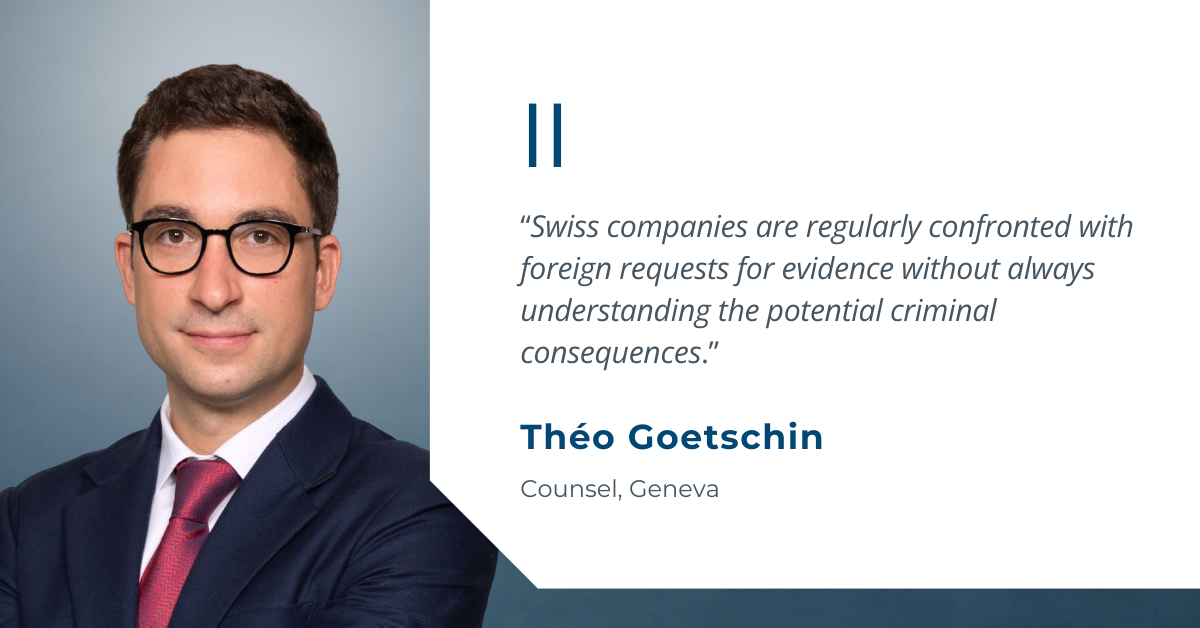
Théo Goetschin
Counsel & Head of the White-Collar Crime group, Geneva
&
Matthieu Tkatch
Associate, Geneva