
Taxpayers will soon lose a significant tax incentive. From 1 January 2029, the abolition of the imputed rental value will result in the restriction or even abolition of several tax deductions, notably those relating to property maintenance costs and interest expenses. In this context, occupational pension provision (2nd pillar) remains one of the principal tax planning tools available to taxpayers who are still professionally active.
In Switzerland, occupational pension provision benefits from a favourable tax regime designed to encourage insured persons to build up sufficient cover for retirement. In this respect, contributions made by employees and self-employed persons to a pension institution, in accordance with statutory or regulatory provisions, are deductible for the purposes of direct federal, cantonal and communal taxes (Art. 81(2) of the Occupational Pensions Act (OPA)).
In return, benefits are taxed when received. Pension payments are fully subject to income tax, whilst lump-sum benefits are taxed separately at a rate corresponding to one-fifth of the ordinary tax rates (Art. 38 of the Federal Act on Direct Federal Taxation (DFTA) and Art. 11(3) of the Direct Taxation Harmonisation Act (DTHA))[1].
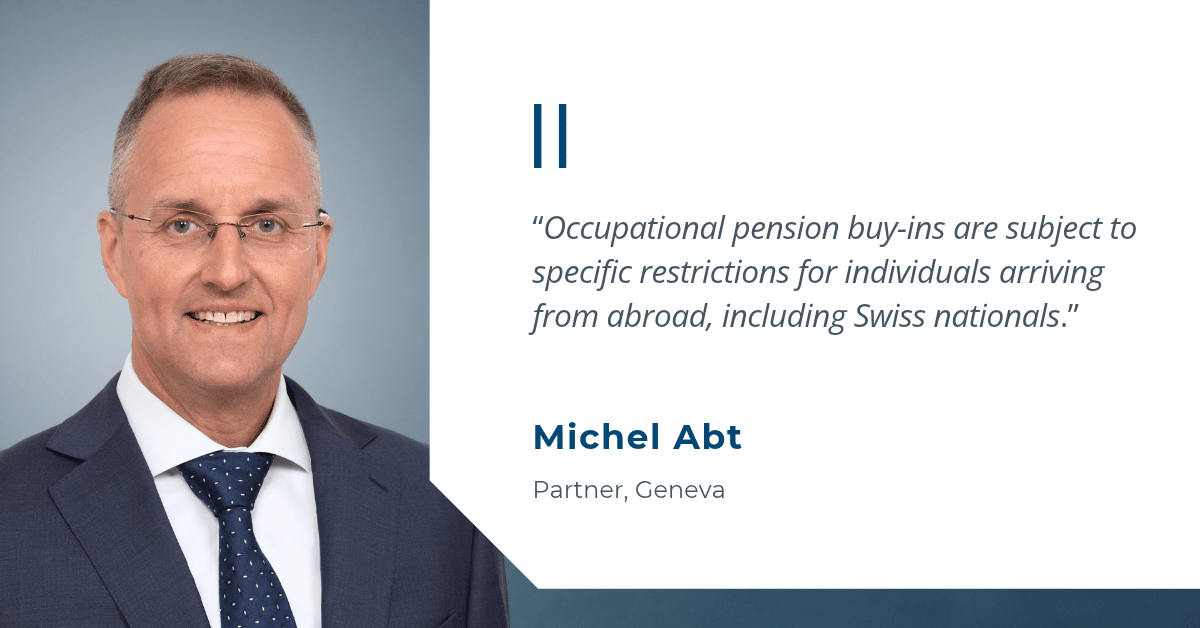
Insured persons may also make voluntary contributions, known as ‘buy-ins’, to make up for gaps in their pension provision, which may arise from extended periods of study, an interruption in employment or a career spent abroad. In the latter case, the possibility of making such buy-ins is subject to certain restrictions.
Thus, Article 60b (1) of the Occupational Pension Ordinance (OPO 2) stipulates that “[t]he annual buy-in amount paid by persons arriving from abroad who have never been affiliated to a pension institution in Switzerland may not exceed, during the five years following their entry into the Swiss pension institution, 20% of the insured salary as defined by the regulations.”
Before departing abroad or returning to Switzerland, it is therefore advisable to review one’s affiliation history, the options for transferring pension assets and the timing of any contemplated buy-ins
Introduced in 2006, this restriction aims to prevent tax abuse, in particular by preventing an individual from taking up temporary residence in Switzerland in order to make substantial buy-ins, deduct the amounts paid and then leave the country shortly thereafter, thereby using their pension fund as a “tax-efficient current account”.
However, an exception is provided for under Article 60b (2) OPO 2: the restriction does not apply where the insured person transfers rights or assets acquired abroad under a foreign occupational pension scheme directly to a Swiss institution, provided that the latter accepts the transfer and no tax deduction is claimed. In practice, however, this possibility remains limited, as few institutions have regulatory provisions allowing them to accept such foreign pension assets.
When called upon to consider this restriction in light of the principle of non-discrimination arising from the Agreement on the Free Movement of Persons (AFMP), the Federal Supreme Court confirmed the interpretation previously adopted by the Federal Social Insurance Office (FSIO), according to which Article 60b (1) OPO 2 applies equally to Swiss and foreign nationals[2]. The decisive criterion is therefore whether the person was previously affiliated with a Swiss pension institution, regardless of the insured person’s nationality.
However, the concept of affiliation may give rise to difficulties for people who worked in Switzerland before the age of 25. Indeed, compulsory insurance covers the risks of death and disability from 1 January following the individual’s 17th birthday, whereas old-age risk coverage generally commences on 1 January following their 24th birthday (Art. 7(1) OPA).
A person who worked in Switzerland between the ages of 19 and 23, before pursuing their career abroad, could therefore argue that they had already been affiliated to a Swiss pension institution. A literal interpretation of Article 60b (1) OPO 2 makes it possible to argue in support of this position. Conversely, an interpretation based on the purpose of the provision could lead to requiring an affiliation including an old-age savings component. To date, this issue has never been settled.
The starting point of the five-year period also deserves particular attention. It does not necessarily correspond to the date of arrival in Switzerland, but rather to entry into a Swiss pension institution. Thus, a person who settles in Switzerland without immediately taking up gainful employment – in particular in order to devote themselves to raising their children – will only have the five-year period begin to run once they actually become affiliated with a pension institution.
Before departing abroad or returning to Switzerland, it is therefore advisable to review one’s affiliation history, the options for transferring pension assets and the timing of any contemplated buy-ins. Such steps make it possible to better anticipate the restrictions that may apply and to take them into account in financial and tax planning.
[1] As part of the 2027 budgetary relief programme, the Federal Council had, amongst other things, proposed increasing the tax on lump-sum withdrawals from the 2nd pillar (FF 2025 3068). This measure was ultimately rejected by Parliament when the programme was adopted in March 2026 (FF 2026 801).
[2] ATF 151 V 343, consid. 6.2.2
Michel Abt
Partner, Geneva
Tax Law (Head of practice)