
A non-compete clause is an ancillary provision to an employment contract whereby the employee undertakes not to engage in a competing activity for a specified period after the termination of the employment relationship. Because it restricts the employee’s economic freedom, the legislator has made its validity subject to strict conditions, foremost among them the requirement of written form. Traditionally associated with a handwritten signature, this requirement must now be assessed in light of the growing digitalization of contractual relationships.
Article 340 para. 1 of the Swiss Code of Obligations (CO) provides that a non-compete clause is valid only if it is concluded in writing. Whether agreed at the time the employment contract is entered into, during its performance, or upon its termination, the written form is not merely a matter of evidence but a genuine condition of validity.
Article 11 para. 1 CO establishes the principle that contracts are subject to a particular form only when the law expressly so requires; the non-compete clause is one such exception. In such cases, Article 13 para. 1 CO requires that the document be signed by all persons assuming obligations under it. Article 14 para. 1 CO further specifies that “the signature must be handwritten by the person assuming the obligation.” According to the settled case law of the Swiss Supreme Court, a contract concluded in breach of a formal requirement is absolutely null and void and produces no legal effect.
For several years now, the traditional concept of written form has been adapted to reflect the increasing digitalization of legal relationships. Accordingly, Article 14 para. 2bis CO provides that a qualified electronic signature is equivalent to a handwritten signature whenever the law requires compliance with the written form.
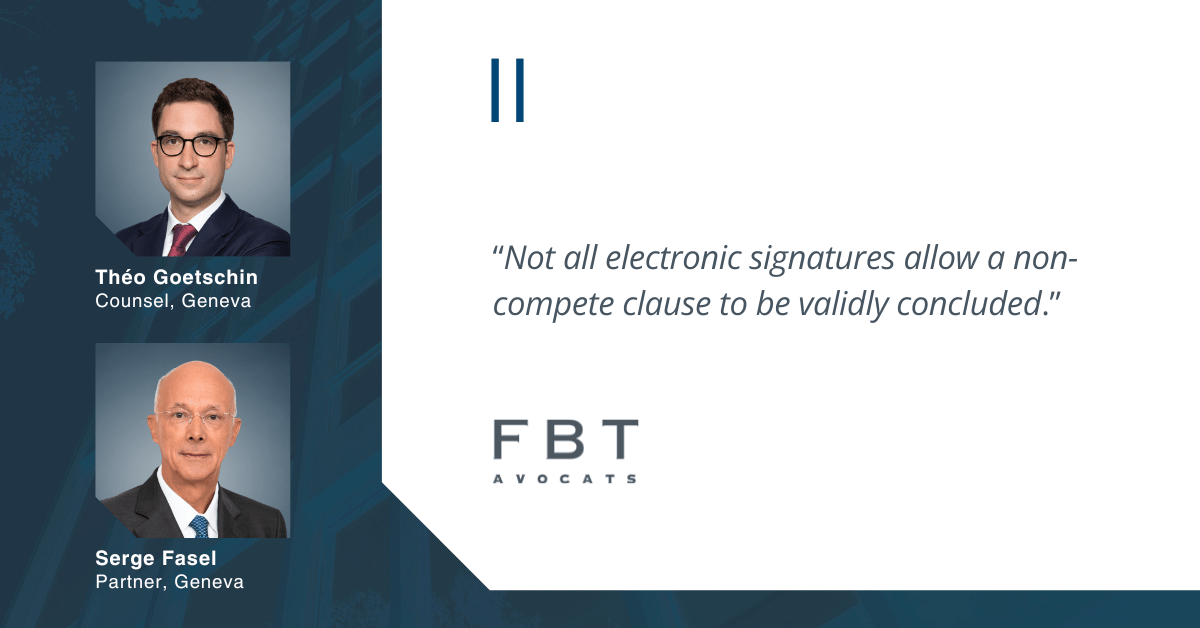
It would, however, be incorrect to conclude that every electronic signature satisfies this requirement. Swiss law distinguishes between several categories of electronic signatures, each having different legal effects. A scanned image of a signature, a signature drawn with a finger on a tablet, clicking an acceptance box, or a simple or advanced electronic signature do not satisfy the requirements of written form. Only a qualified electronic signature, issued in accordance with federal law by a recognized service provider, is equivalent to a handwritten signature.
This distinction is of particular practical importance in employment law. Today, employment contracts are increasingly concluded using electronic signature solutions available on the market, such as DocuSign, Adobe Acrobat Pro, or Dropbox Sign.
Although most of these platforms offer several levels of signature, the mere use of one of them does not in itself guarantee compliance with Swiss requirements regarding written form. Everything depends on the signature process actually used and, more specifically, on whether it meets the conditions of a qualified electronic signature under federal law. Mere compliance with the European eIDAS Regulation (electronic Identification, Authentication and Trust Services) is therefore not sufficient to ensure compliance with Swiss legal requirements.
While an employment contract is, in principle, a consensual contract that does not require any particular form to be valid (Art. 320 para. 1 CO), the non-compete clause remains subject to the mandatory requirement of written form. Consequently, an employment contract may be perfectly valid even though the non-compete clause it contains is ineffective because the formal requirements have not been met.
The consequences of such an irregularity may be considerable, since a non-compete clause that does not comply with the formal requirements produces no legal effect. The employer will therefore be unable either to prevent a former employee from engaging in a competing activity on that basis or to rely on any contractual penalty stipulated in the event of a breach of the clause.
In practice, employers should therefore give preference to the services of a recognized1, certification service provider, allowing the affixing of a qualified electronic signature recognized under Swiss law. Failing that, the use of a handwritten signature is recommended. If the employment contract nevertheless needs to be concluded without delay and neither of these solutions is feasible, it remains possible to have only the non-compete clause signed at a later stage in compliance with the formal requirements. This solution is not without risk, however, since the employee, once hired, may refuse to sign such a clause.
The authors would like to thank Sara Pugliese-Charfadi for her assistance in preparing this article.
1The Swiss Accreditation Service (SAS) publishes and maintains an official list of recognized certification service providers: https://www.seco.admin.ch/en/csp-electronic-signature (consulted on 22 July 2026).
Théo Goetschin
Counsel, Geneva
&
Serge Fasel
Partner, Geneva
Employment Law (Heads of practice)